
Carissimi Associati SGI,
Carissimi Soci delle Società Associate,
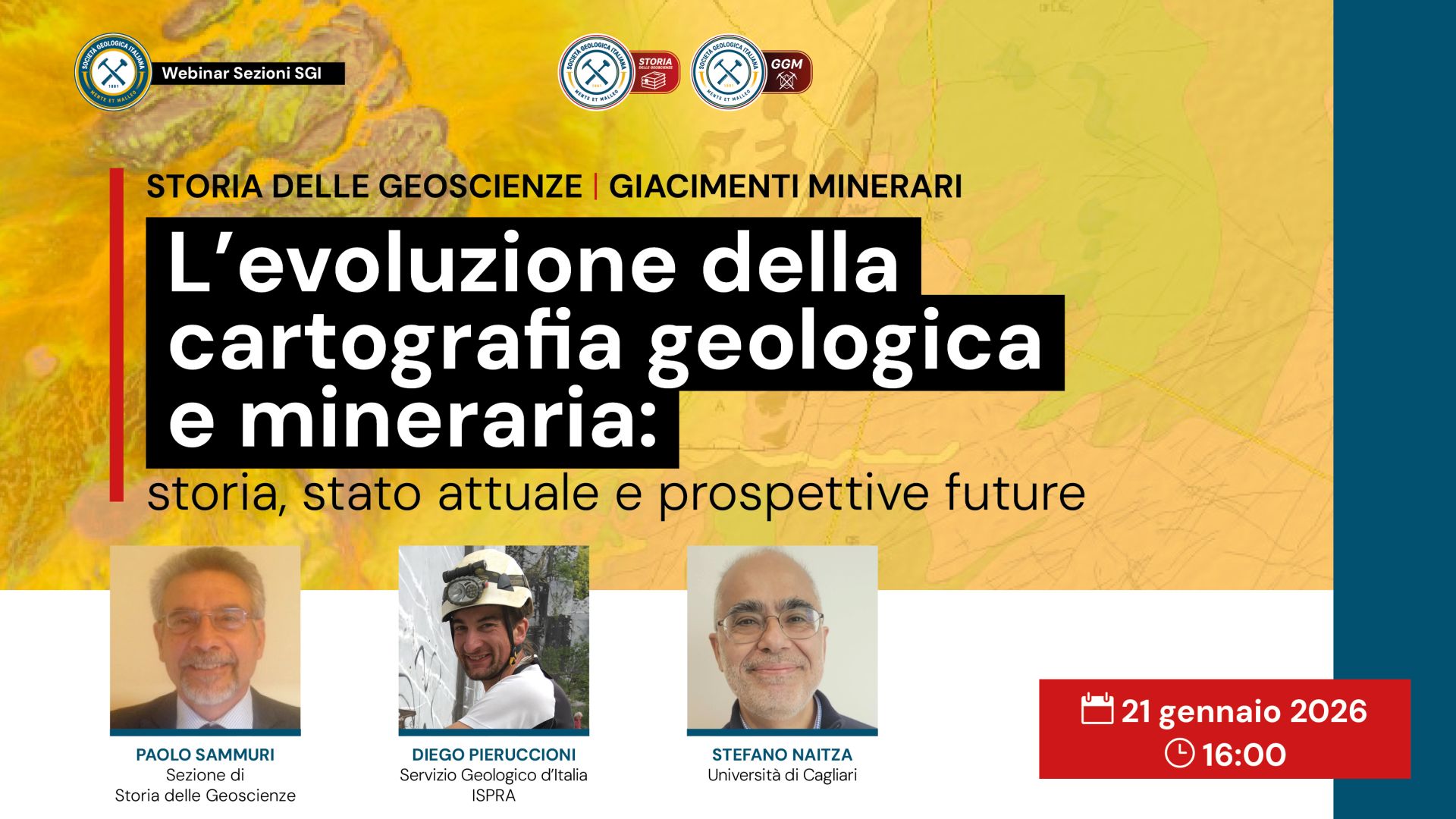
vi ricordiamo che il primo webinar del ciclo organizzato dalle Sezioni della SGI si terrà mercoledì 21 gennaio 2026, a partire dalle ore 16:00.
Il webinar, intitolato "L'evoluzione della cartografia geologica e mineraria: storia, stato attuale e prospettive future", è organizzato dalle sezioni di Storia delle Geoscienze e di Giacimenti Minerari e sarà tenuto da Paolo Sammuri, Diego Pieruccioni e Stefano Naitza. L'incontro affronterà il tema dell'evoluzione storica e metodologica della cartografia geologica e geo-mineraria, dalle prime rappresentazioni settecentesche agli strumenti digitali attuali.
Per partecipare sarà possibile collegarsi tramite la piattaforma Zoom utilizzando il seguente link:
https://us06web.zoom.us/j/82172069074?pwd=vJGPPP4hfMcaPHaeu9KJPi4e5PL1Ul.1
ID riunione: 821 7206 9074
Codice d'accesso: 754309
Per ulteriori informazioni vi rimandiamo al testo riportato di seguito, dove, oltre alla descrizione dettagliata degli interventi, è disponibile una breve biografia dei relatori.
Cordiali saluti,
La Segreteria SGI
"The evolution of geological and mining cartography: History, current status, and future perspectives"
Geological and geo-mining cartography form the basis for the identification and exploitation of underground mineral resources. This webinar consists of three presentations describing the evolution of geo-mining cartography from the 18th century to the present day.
First talk: "The ancient geological and mining maps from the eighteenth century" (Paolo Sammuri)
During the Regency period and the early Habsburg-Lorraine era, the new rulers needed to identify and evaluate the economic potential of the Grand Duchy of Tuscany's resources, such as agriculture, industry, and raw materials. Numerous mining areas were inspected and mapped under the regents of Francesco Stefano of Lorraine and then, under Pietro Leopoldo. This talk presents and discusses hand-drawn mining maps created by two cartographers, Carlo Maria Mazzoni and Francesco Antonio Eegat, each of which is a unique copy. Four Mazzoni's maps of the Apuan Alps are examined, depicting the "Acuti", "Gabbari", "Corchia", and "Salioni" mountains near Pietrasanta. Eegat's four maps depict southern Tuscany and the areas surrounding "Massa Marittima", "Monterotondo Marittimo", "Montecatini", and "Querceto". The maps analyze the graphic techniques employed and the geological and technical information relating to the mines they depict.
Second talk: "Current exploration and cartography of mines compared with ancient maps" (Diego Pieruccioni)
The southern Apuan Alps have long been known for their mineral resources, and mining activity has characterised life in this area for many centuries. The most historically relevant of all the known mining sites are the Argentiera di Sant'Anna and the Sciorinello-Senicioni mining complex in Stazzema. These mining sites are known for their lead-zinc-silver ore and have been exploited since the 13th century. However, it was not until the 16th century, under the Medici family, that a proper mining industry was established. The exploration and topographic survey of these mining complexes, along with a comparison with existing cartography, made it possible to delineate the underground heritage. The mining complex consists of 19 main underground mines and 12 minor excavations, totalling a spatial development of around 5 km, of which approximately 36% are ancient tunnels entirely hand-dug.
Third talk: "Metallogenic mapping in Sardinia: from ancient maps to digital cartography" (Stefano Naitza)
Sardinia is Italy's main historical mining region, with over 2,000 years of exploitation of lead, zinc, copper, antimony, and silver ores, hosted in various types of mineral deposits. A distinctive feature of Sardinian metallogeny is the uneven distribution of deposits, mainly concentrated in the southwestern (Iglesiente, Sulcis, Arburese) and southeastern (Sarrabus and Gerrei) districts. The first representations of Sardinia's mineral resources date back to the 18th and 19th centuries, including the 1763 Piedmontese map and Quintino Sella's mining map of 1871, followed by several updates in the 20th century. The first metallogenic map integrating modern metallogenic concepts was produced by Ente Minerario Sardo in 1978 and later improved by the University of Cagliari in 2008. Within the "Geosciences IR" project coordinated by ISPRA, a new metallogenic map of Sardinia has been developed in collaboration with the University of Cagliari. Created in a GIS environment and based on regional geological cartography, the map improves accuracy, scalability, and data integration. Historical mining data have been verified and incorporated into a relational geodatabase, with particular attention to critical raw materials, supporting resource classification, economic evaluation, and future exploration planning.
Paolo Sammuri
He was born in Rome in 1951 and graduated in Chemistry and Geology. He has worked for the Ministry of Cultural Heritage's Central Institute for Restoration, the Ministry of Industry's Chemical Service of the Mining Corps, and the Ministry of the Interior's Scientific Police Service of the State Police. He is a member of the Academy of Physiocritics, the Tuscan Society of Natural Sciences, and the Italian Volcanology Association.
Diego Pieruccioni
He was born in Pietrasanta (LU) in 1987 and graduated in Geological Sciences at Pisa University in 2012 with a master's thesis in structural geology on geological mapping and structural analysis of the poly-deformed area of the Central Apuan Alps. Subsequently, between 2013 and 2016, he undertook a Ph.D. in Earth Sciences at the Department of Chemical and Geological Sciences of Cagliari University. Since 2020, he has worked as a Researcher at the Geological Survey of Italy (ISPRA) for the National geological mapping project (CARG Project at 1:50,000 scale).
Stefano Naitza
He was born in Cagliari in 1965 and graduated in Geological Sciences at the University of Cagliari in 1992. After obtaining his Ph.D. in Mineral Exploration (1997), he has been a Researcher in Ore Geology at the University of Cagliari since 2002, where he currently teaches Economic Geology. His main research topics concern Variscan to post-Variscan metallogeny, orogenic gold deposits, granite-related deposits, granite metallogeny, metallogenic mapping, studies on CRMs, and the sustainable recovery of raw materials from mining waste. He is the current President of the Sardinian Mining Association.