
Carissimi Associati SGI,
Carissimi Soci delle Società Associate,
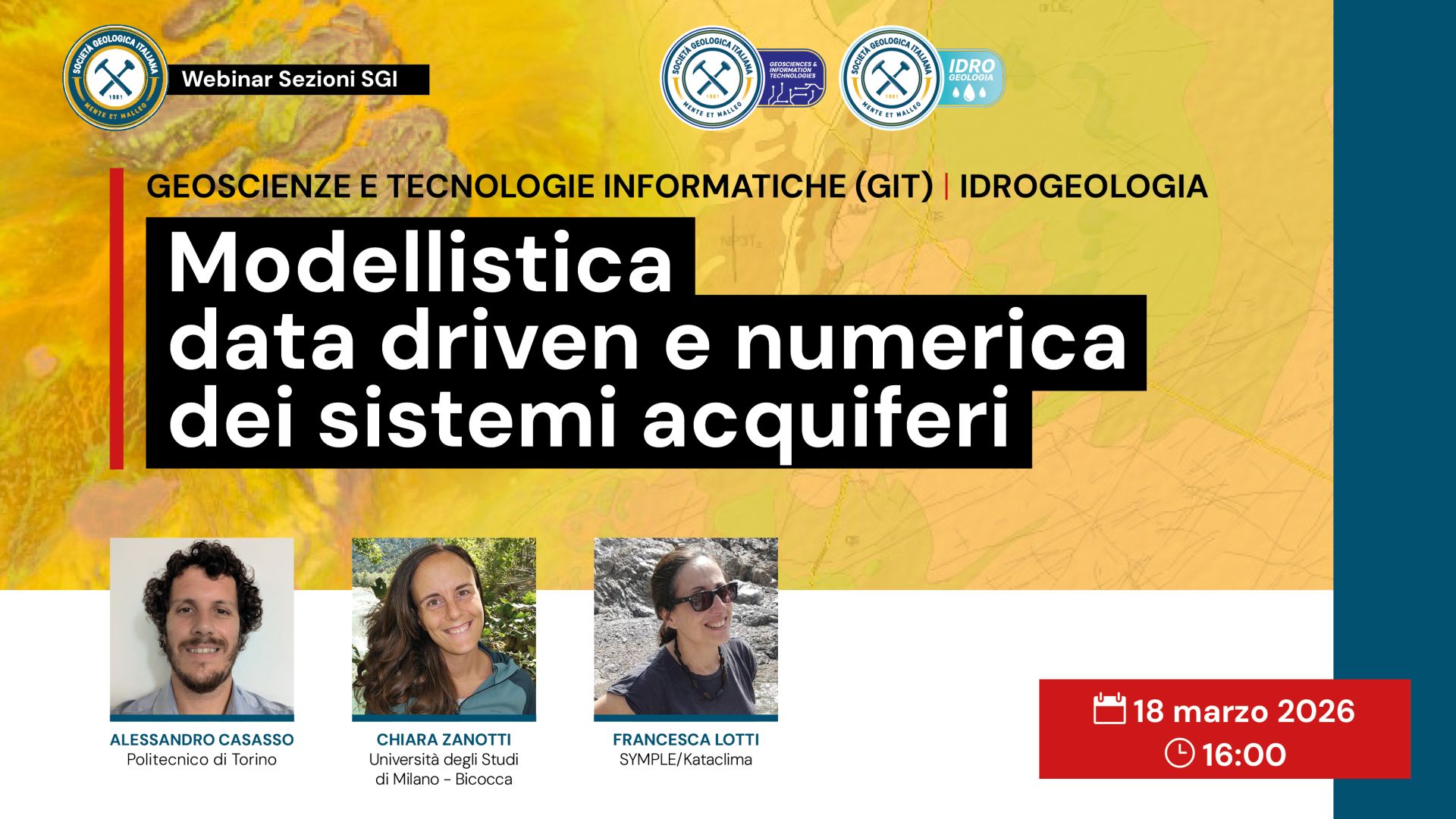
si comunica che il terzo webinar del ciclo organizzato dalle Sezioni della SGI si terrà mercoledì 18 marzo 2026, a partire dalle ore 16:00.
Il webinar, intitolato "Modellistica data driven e numerica dei sistemi acquiferi", è organizzato dalle sezioni di Geoscienze e Tecnologie informatiche (GIT) e di Idrogeologia e sarà tenuto dal Prof. Alessandro Casasso (Politecnico di Torino), dalla Prof.ssa Chiara Zanotti (Università di Milano Bicocca) e dalla Dott.ssa Francesca Lotti (SYMPLE/Kataclima).
Il webinar propone tre interventi dedicati all'impiego di approcci data-driven e di modellazione numerica nello studio delle acque sotterranee. Attraverso casi applicativi, i relatori illustreranno come l'analisi dei dati e i modelli idrogeologici possano supportare la comprensione dei processi che regolano gli acquiferi. Gli interventi offriranno inoltre spunti utili per la gestione e la tutela sostenibile delle risorse idriche sotterranee.
Per partecipare sarà possibile collegarsi tramite la piattaforma Zoom utilizzando il seguente link:
https://us06web.zoom.us/j/83166355100?pwd=cM2WkeuAra2mvbbPJD4eBznndbUTDa.1
ID riunione: 831 6635 5100
Codice d'accesso: 584397
Per ulteriori informazioni vi rimandiamo al testo riportato di seguito, dove, oltre alla descrizione dettagliata degli interventi, è disponibile una breve biografia dei relatori.
Cordiali saluti,
La Segreteria SGI
Groundwater data driven and numerical modelling
This webinar consists of three presentations describing different types of groundwater modelling applied in different environmental contexts and with different purposes.
First talk: Numerical modelling of low-enthalpy geothermal plants (Alessandro Casasso)
Shallow geothermal systems have become increasingly popular as a low-carbon solution for the heating and cooling of buildings and have a great potential for data centres cooling and district heating. These plants use groundwater and the shallow subsurface as a heat source or sink for a heat pump, thus leading to the formation of a thermally altered portion in the subsurface called thermal plume. Assessing thermal plumes is key to ensure the correct operation of the plant and, in urban areas, the sustainable co-existence of several plants in relatively small spaces. This presentation will demonstrate, with a few practical examples, the impact assessment of shallow geothermal systems through the numerical simulation of flow and heat transport with different software.
Second talk: Piezometric time series analysis from pumping wells for climate change vulnerability assessment (Chiara Zanotti)
Investigating groundwater vulnerability to climate change is a key challenge for sustainable water resources management, especially in regions where irrigation strongly controls aquifer recharge and depletion. Traditional hydrogeological analyses typically rely on monitoring networks and the acquisition of static piezometric data, whereas in this work, high-frequency water-level records from active drinking wells are processed to extract representative time series of piezometric data. The seminar first illustrates the methodological framework adopted to filter pumping noise and derive reliable groundwater time series from operational data. It then compares the seasonal behavior of different aquifer systems under baseline conditions with their response during the 2022 drought, highlighting the dual role of irrigation depending on whether it is supplied by surface water or groundwater. Finally, the observed changes in seasonal patterns are interpreted in terms of climate forcing and water-management practices, showing how increased abstraction and reduced surface water availability can amplify groundwater depletion. The results demonstrate that properly treated pumping-well data provide a powerful and widely available source of information for assessing groundwater vulnerability and supporting climate change adaptation and sustainable water resources management.
Third talk: Numerical modelling applied to the delimitation of the Safeguard Areas of drinking water catchments (Francesca Lotti)
The delineation of groundwater protection zones for drinking-water abstractions is a critical component of water-resource management and regulatory compliance. Current practice relies on geometric, temporal, and hydrogeological criteria, as defined by national and European regulations, yet their practical implementation is often challenged by data scarcity, parameter uncertainty, and aquifer heterogeneity. This seminar presents a comparative overview of analytical and numerical approaches for defining wellhead capture zones and sanitary protection areas, with a specific focus on how uncertainty in hydrogeological parameters propagates into protection-zone boundaries. Deterministic analytical solutions are first discussed, followed by probabilistic extensions in which uncertain parameters are described through ranges and probability density functions, yielding capture zones expressed as likelihood distributions rather than fixed boundaries. The second part of the webinal explores probabilistic numerical modeling based on MODFLOW coupled with data assimilation techniques (PEST), using multiple equiprobable and equally calibrated realizations to represent subsurface heterogeneity and parameter uncertainty.
Alessandro Casasso
Alessandro Casasso is a civil engineer with expertise in groundwater monitoring, characterization, and modelling, in particular aimed at shallow geothermal systems and managed aquifer recharge. He is Associate Professor at Politecnico di Torino. His research addresses several different aspects of shallow geothermal systems, from the assessment of their impact on the subsurface to their energy efficiency, emissions, economic feasibility, and policy aspects. He is currently leading a project on demonstration of managed aquifer recharge with the off-season use of irrigation channels.
Chiara Zanotti
Chiara Zanotti is a hydrogeologist with expertise in groundwater dynamics, climate change impacts, and water resource management. She is an Assistant Professor at the University of Milano-Bicocca. Her research combines time-series analysis, multivariate statistics, and machine learning to investigate groundwater quality and availability, groundwater vulnerability, and surface–groundwater interactions, with applications ranging from drinking-water protection and Water Safety Plans to natural and anthropogenic background levels and climate-change adaptation.
Francesca Lotti
Francesca Lotti is a hydrogeologist, numerical modeler, and trainer with over 20 years of experience in field investigations and groundwater modelling of contaminated sites, mining, geothermal projects, coastal aquifers, complex dewatering systems, etc. She regularly delivers professional training courses, corporate mentoring, and lectures within second-level Master's programs. In 2021, she founded SYMPLE (School of Hydrogeological Modelling) which has grown into an international community with more than 1,000 participants over its first five years.