
Carissimi Associati SGI,
Carissimi Soci delle Società Associate,
si comunica che il quarto webinar del ciclo organizzato dalle Sezioni della SGI si terrà giovedì 23 aprile 2026, a partire dalle ore 16:00.
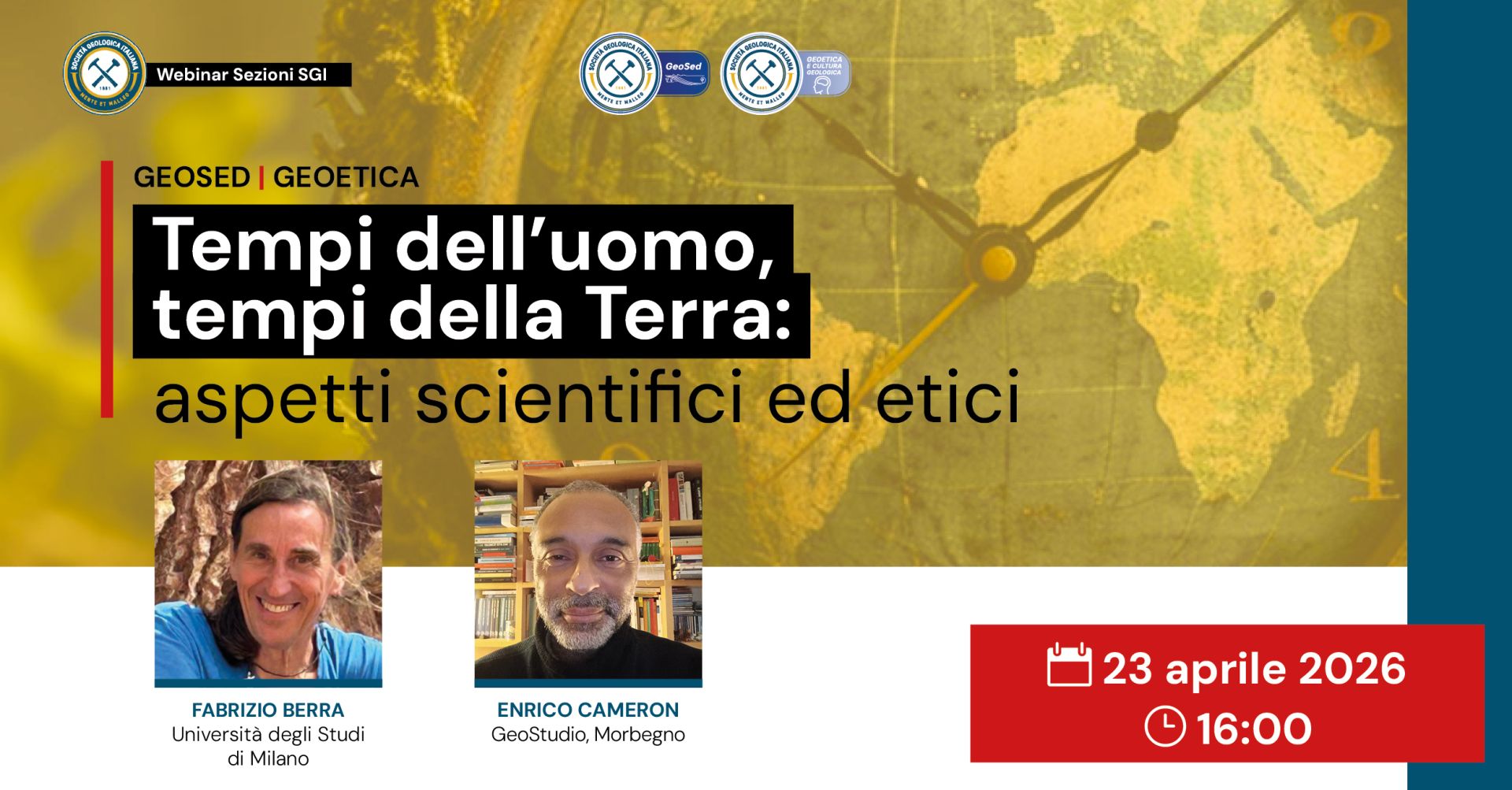
Il webinar, intitolato "Tempi dell'uomo, tempi della Terra: aspetti scientifici ed etici", è organizzato dalle sezioni GeoSed e di Geoetica e Cultura Geologica e sarà tenuto dal Prof. Fabrizio Berra (Università di Milano) e dal Dott. Enrico Cameron (GeoStudio, Morbegno).
Gli interventi illustreranno la complessità dei processi geologici, caratterizzati da scale temporali diverse e da una prevedibilità variabile, evidenziando la discrepanza tra tempi naturali e tempi umani e le implicazioni nei processi decisionali. Sarà inoltre analizzato il ruolo crescente delle attività antropiche come forza geologica e il loro impatto sul cambiamento climatico e sui sistemi ambientali. In questo contesto, verrà approfondita la geoetica come prospettiva integrata tra scienza ed etica, con particolare riferimento al Relational Geoscientific Pragmatism come approccio operativo.
Per partecipare sarà possibile collegarsi tramite la piattaforma Zoom utilizzando il link che verrà comunicato un'ora prima dell'inizio dell'evento
Per ulteriori informazioni vi rimandiamo al testo riportato di seguito, dove, oltre alla descrizione dettagliata degli interventi, è disponibile una breve biografia dei relatori.
Cordiali saluti,
La Segreteria SGI
Tempi dell'uomo, tempi della Terra: aspetti scientifici ed etici
Il nostro pianeta è caratterizzato dalla coesistenza di molteplici processi geologici che operano su scale temporali diverse, con frequenze sia regolari sia irregolari. Questi processi si rapportano in modi differenti con la scala temporale propria della vita umana: alcuni eventi hanno frequenze documentate storicamente, altri sono documentati solo a livello geologico. La loro natura, le loro caratteristiche e la loro scansione nel tempo influenzano direttamente la loro prevedibilità e il loro ruolo nei processi decisionali, nell'ambito delle incertezze che sono pressoché inevitabili nelle Scienze della Terra. Questa discrepanza tra tempi umani e tempi geologici rappresenta una sfida per la valutazione degli impatti dei fenomeni naturali sulle attività umane. La frequenza dei fenomeni naturali risente anche delle attività degli esseri umani che sono divenuti una vera e propria forza geologica soprattutto a partire dalla seconda rivoluzione industriale; capace di influenzare in modo rilevante i flussi di materia ed energia del sistema Terra. Le attività antropiche hanno inciso sul cambiamento climatico che stiamo vivendo, producendo una significativa accelerazione dei cambiamenti ambientali. I complessi aspetti culturali, economici, geopolitici e tecnologici delle società umane, insieme alla scala dei problemi ambientali attuali, fanno sì che tali questioni — e le loro conseguenze sociali — assumano inevitabilmente anche una dimensione etica. Ne derivano la necessità di affrontare questi problemi in modo integrato, prestando attenzione non solo agli aspetti tecnologici, ma anche a quelli etici, e un mutamento di ruolo di chi opera nelle geoscienze. In questo contesto si inserisce la geoetica, intesa come ambito di ricerca e riflessione sui valori che guidano comportamenti e pratiche appropriate ogniqualvolta le attività umane interagiscono con il sistema Terra. Originatasi come riflessione sulle implicazioni etiche, sociali e culturali della conoscenza geoscientifica, la geoetica si sta evolvendo verso una prospettiva più ampia, configurandosi come un'etica globale delle relazioni tra esseri umani e pianeta, attraverso una sintesi tra scienza ed etica, natura e cultura, e altre prospettive etiche. In tale quadro, il Relational Geoscientific Pragmatism si propone come un approccio operativo per l'applicazione della geoetica stessa, offrendo strumenti per affrontare in modo consapevole e contestuale la complessità delle decisioni che emergono dall'interazione tra sistemi naturali e società umane.
Our planet is characterized by the coexistence of multiple processes operating across different timescales, with both regular and irregular frequencies. These processes relate in different ways to the characteristic timescale of human life: some events have historically documented frequencies, others are documented only at a geological level. Their nature, properties, and temporal patterns directly influence their predictability and their role in decision-making processes, within the uncertainties that are almost unavoidable in the Earth sciences. This discrepancy between human timescales and geological timescales represents a challenge for the forecasting and evaluation of the impacts of natural phenomena on human life. The frequency of natural phenomena is also affected by the activities of human beings who act as a geological force especially since the second industrial revolution; capable of significantly influencing the flows of matter and energy within the Earth system. Human activities have affected the climate change we are experiencing, producing a significant acceleration of environmental change. The complex cultural, economic, geopolitical, and technological dimensions of human societies, together with the scale of current environmental problems, mean that these issues—and their social consequences—inevitably also take on an ethical dimension. This gives rise to the need to address these challenges in an integrated way, paying attention not only to technological aspects but also to ethical ones, and entails a shift in the role of those working in the geosciences. In this context, geoethics emerges as a field of research and reflection on the values that underpin appropriate behaviors and practices wherever human activities interact with the Earth system. Originally developed as a reflection on the ethical, social, and cultural implications of geoscientific knowledge, geoethics is evolving toward a broader perspective, becoming a global ethics of the relationships between human beings and the planet, through a synthesis of science and ethics, nature and culture, and other ethical perspectives.
Within this framework, Relational Geoscientific Pragmatism is proposed as an operational approach for the application of geoethics, providing tools to address, in a conscious and context-sensitive way, the complexity of decisions arising from the interaction between natural systems and human societies.
Fabrizio Berra
As full Professor of Geology at the Department of Earth Sciences of the University of Milan, his scientific activity focuses primarily on sedimentary geology, with particular emphasis on stratigraphy, paleogeography, and basin analysis across a range of paleoenvironmental settings.
He has conducted research in both national and international contexts, integrating fieldwork and laboratory analyses. He has been involved in the national geological mapping projects (CARG) and he coordinated national research projects as well as collaborations with public institutions and industry partners.
Alongside his research activities, he is actively involved in teaching within undergraduate and graduate programs in Geology and has held several academic and organizational roles. His research output includes numerous scientific publications in international journals and contributions to various conferences. In recent years, he has promoted multiple outreach initiatives aimed at engaging the general public and school communities with geology. He is also the author of La scienza e la Terra (Scienza Express Editions), a science essay written for a wide audience.
Enrico Cameron
He is a freelance geologist, educator, and a member of the National Coalition of Independent Scholars (NCIS). He graduated in Geology from the University of Pavia and obtained a PhD focusing on the application of machine learning and probabilistic decision networks for the analysis and management of groundwater contamination risk. He currently coordinates the Geoethics and Geological Culture section of the Italian Geological Society, which is the Italian chapter of the International Association for Promoting Geoethics (IAPG). His published works in international journals address topics such as hydrogeology, geological heritage, risk analysis, and geoethics.